
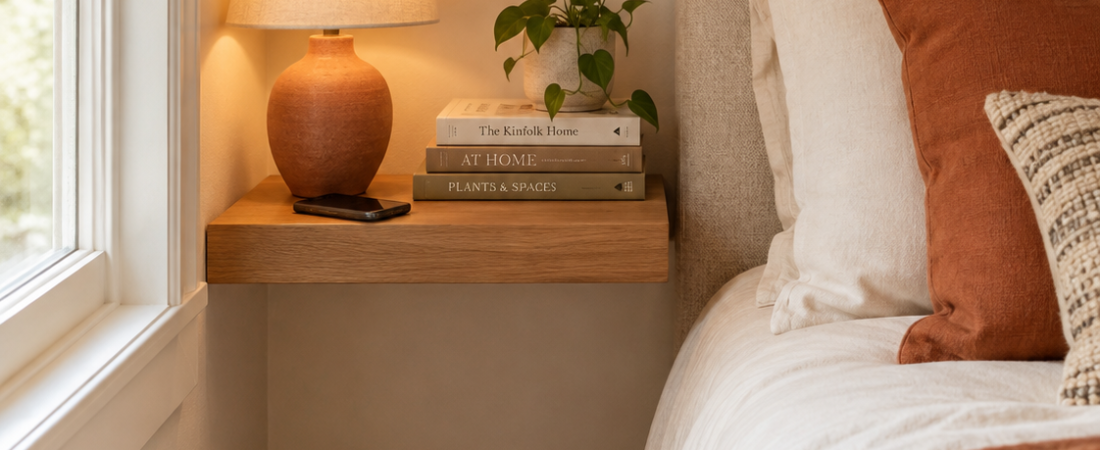
If your bed is pushed into a corner or wedged between a wall and a closet door, you already know the problem: there’s no room for a nightstand, so your phone charger, glasses, and water glass end up on the floor. It’s not just messy — it means fumbling in the dark and stubbing your toe on a book pile at 2 a.m. These 10 small bedroom side table alternatives solve the space problem without sacrificing a landing spot for your essentials, and most work in rentals too.
1. A Single Floating Wall Shelf
The problem: A standard nightstand needs at least 14–16 inches of floor depth, which most tight bedroom corners simply don’t have.
The solution: Mount one floating shelf, 10–12 inches deep, at mattress height (roughly 24–26 inches off the floor). It holds a lamp, phone, and glass with zero floor footprint.
The benefit: You get a full landing surface while freeing up the entire floor space beside your bed — easier to vacuum, easier to walk past, and no stubbed toes in the middle of the night.
Practical details: Use a low-profile bracket shelf that installs with wall anchors, or a Command-strip-rated version for renters. Keep it to one shelf per side; two stacked shelves start to look cluttered in a tight room. Shop this style: Filano Floating Nightstand Shelf with Drawer.
2. A Wall-Mounted Swing-Arm Lamp With a Tiny Shelf Below
The problem: Without a nightstand, you also lose your bedside lamp — and overhead lighting alone feels harsh at night.
The solution: Install a swing-arm or gooseneck wall lamp above where a nightstand would sit, paired with a 6-inch mini shelf just below it for your phone.
The benefit: This eliminates the need for a separate table lamp entirely, so you solve the lighting problem and the surface problem in one 8-inch-wide fixture.
Practical details: Look for plug-in versions with a cord cover that mimic a hardwired look — no electrician needed, and it’s fully removable when you move out. Shop this style: HOXIYA Dimmable Swing-Arm Plug-In Wall Lamp.
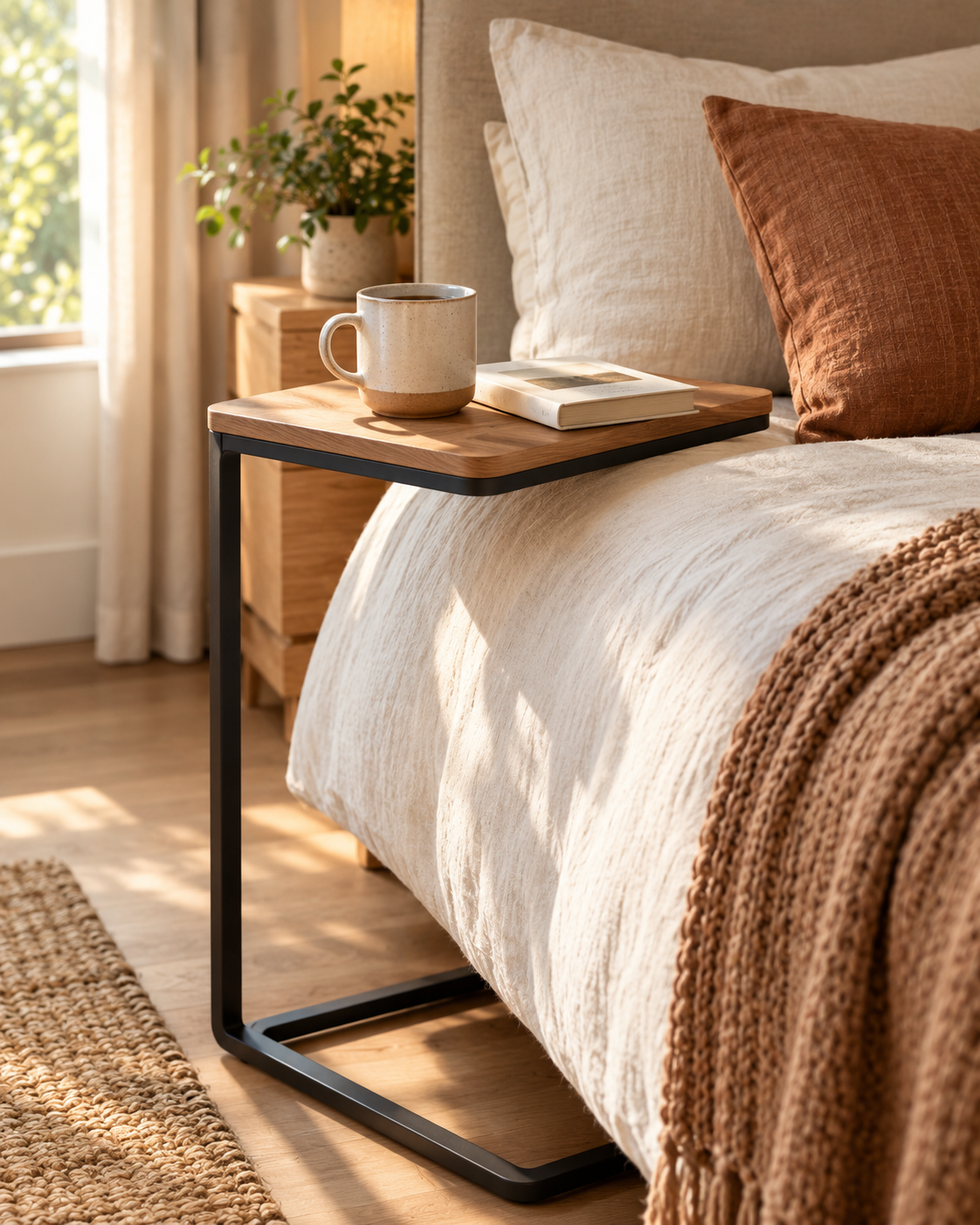
3. A C-Shaped Side Table
The problem: Even a slim table needs floor space next to the bed, which a tight layout doesn’t have.
The solution: A C-table has a base that slides under the bed frame, letting the tabletop hover over the mattress edge instead of sitting on the floor beside it.
The benefit: It requires zero additional floor space since the base tucks beneath the bed, making it the closest functional swap for a real nightstand.
Practical details: Measure your bed’s frame clearance first — most C-tables need at least 2–3 inches of gap under the frame. A 20-inch-wide top is enough for a lamp and book. Shop this style: WLIVE C-Shaped End Table.
4. A Vintage Stool or Small Bench
The problem: Built-for-purpose nightstands often come in one fixed size, which won’t squeeze into an irregular gap.
The solution: A small wooden stool, vintage step stool, or narrow bench (12–14 inches wide) slides into odd-shaped corners a boxy nightstand can’t fit.
The benefit: You get a flexible surface that adapts to your exact gap width instead of forcing your layout to match a standard furniture size.
Practical details: Thrift stores and flea markets are the cheapest source — expect $10–$25 for a solid wood stool. A flat top (not woven or slatted) works best for holding a glass of water. Shop this style: HOEGMST Live Edge Wood Stool Side Table.
5. A Fold-Down Wall Shelf
The problem: In very narrow rooms, even a floating shelf can feel like it’s eating into walking space.
The solution: Install a hinged, fold-down shelf that lies flat against the wall when not needed and drops to a horizontal surface at bedtime.
The benefit: It disappears completely during the day, so a room that also functions as a walkway or home office doesn’t feel cramped by daytime furniture.
Practical details: These typically cost $20–$40 and mount with 3–4 screws into a stud. Choose one rated to hold at least 10 lbs if you’re setting a lamp on it. Shop this style: PureBox Foldable Wall Shelf.
6. A Slim Rolling Bar Cart
The problem: A fixed nightstand can’t move if you rearrange your room or need extra surface space temporarily.
The solution: A narrow two-tier bar cart (14–16 inches wide) rolls into a tight gap and rolls right back out when you need to clean or reconfigure.
The benefit: The bottom shelf gives you extra hidden storage for books or skincare that a single-surface alternative doesn’t offer, and it relocates in seconds.
Practical details: Look for one with locking wheels so it doesn’t drift during the night. Metal wire carts run $30–$50 and fit a light, airy or industrial bedroom style. Shop this style: 2-Tier Metal Rolling Bar Cart.
7. Stacked Vintage Suitcases or Wooden Crates
The problem: Budget nightstands that fit tiny spaces are surprisingly hard to find under $50.
The solution: Stack two vintage suitcases or wooden crates of decreasing size to create a side table with storage inside. For more ways to stretch a small-bedroom budget, see our low-cost minimalist bedroom ideas.
The benefit: You get a table and concealed storage for chargers, lotion, or extra pillowcases — hiding clutter instead of just having a surface for it to collect on.
Practical details: Secure the stack with furniture pads or a thin strip of hook-and-loop tape between layers so it doesn’t shift when you reach for your phone in the dark. Shop this style: DECOR4SEASON Wooden Vintage Suitcase Set.
8. A Leaning Ladder Shelf
The problem: A boxy nightstand visually blocks light and makes a small room feel more enclosed.
The solution: A slim ladder shelf leans against the wall at an angle, using vertical space instead of floor footprint, with 2–3 tiers for a lamp, book, and small plant.
The benefit: Because it’s open on the sides, it keeps sightlines clear across the room, which makes a small bedroom read as noticeably more open than a solid nightstand would.
Practical details: Standard ladder shelves are 14–16 inches wide at the base — measure your gap before buying, since the angled lean needs a bit more floor clearance at the bottom than a straight table. Shop this style: Solid Wood 3-Tier Ladder Shelf.
9. A Wall-Mounted Basket or Pocket Organizer
The problem: Even without a nightstand, you still need somewhere for your phone, glasses, and lip balm that isn’t the floor.
The solution: A hanging fabric or wire basket mounted at bed height holds small essentials without any horizontal surface at all.
The benefit: It’s the most budget-friendly and fully removable option on this list — ideal for renters who want zero wall damage and zero furniture cost.
Practical details: Over-the-headboard or over-the-bed-frame hanging organizers need no tools at all. Expect to pay $10–$20, and it works especially well for a daybed or platform bed with a visible frame edge. If your whole room feels tight rather than just the bedside, our affordable small bedroom storage ideas covers more no-tool solutions like this one. Shop this style: No-Drill Hanging Bedside Caddy.
10. A Headboard With a Built-In Ledge
The problem: Buying furniture piece by piece (bed, then a separate side solution) adds cost and clutter.
The solution: Choose or DIY a headboard with a built-in shelf ledge along the top, wide enough for a lamp and phone directly behind your pillow.
The benefit: This combines two furniture pieces into one purchase, saving both money and the floor space a separate table would need.
Practical details: Floating headboard shelves mount independently of the bed frame, so they work with platform beds, daybeds, or beds pushed flush into a corner — a trick that also comes up in our small guest bedroom ideas for beds with no side clearance at all. Shop this style: No-Screws Headboard Shelf Attachment.
The Bottom Line
You don’t need a traditional nightstand to have a functional, good-looking bedside setup. Whether you go with a $15 floating shelf or a stacked pair of vintage suitcases, the goal is the same: get your essentials off the floor and give your small bedroom room to breathe. Pick the option that matches your gap size and budget, and you’ll never have to fumble for your phone in the dark again.
FAQ
What’s the cheapest nightstand alternative for a small bedroom?
A wall-mounted basket or pocket organizer is typically the least expensive option, often under $20, and requires no tools or wall damage.
How much floor space do I actually need for a nightstand alternative?
Wall-mounted shelves and organizers need none at all. C-tables need 2–3 inches of clearance under the bed frame but no side floor space. Rolling carts and stools still need 12–16 inches of floor width.
Will these options work in a rental apartment?
Yes — floating shelves with Command-rated brackets, hanging organizers, rolling carts, and stacked suitcases all avoid permanent wall damage and can move with you.
What if my bed doesn’t have room on either side at all?
A C-table or a headboard with a built-in ledge are your best bets, since both use the bed itself rather than adjacent floor space.