
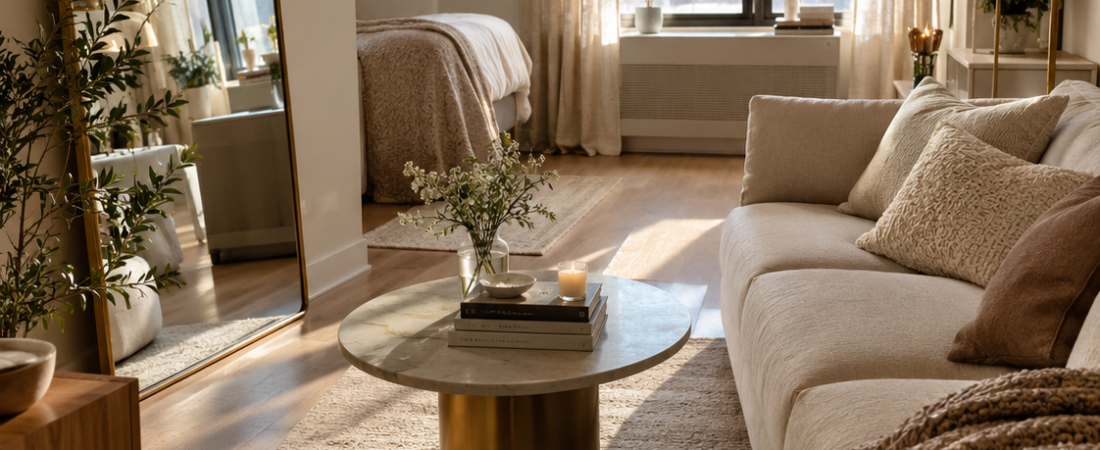
If you’ve ever stood in the middle of your studio or one-bedroom and felt the walls creeping in, you’re not imagining things — and you’re definitely not alone. Small apartment decor ideas tend to fall into two unhelpful camps online: “just declutter” (thanks, very original) or full gut-renovation inspiration that assumes you own the walls you’re staring at. Neither one solves the actual problem, which is that cramped doesn’t have to mean cheap.
The truth is, some of the most beautiful interiors in the country live in 500-square-foot rentals. What separates a small space that feels tight from one that feels intentionally cozy and expensive comes down to a handful of decisions — most of which cost far less than a renovation and none of which require you to move a wall.
Why Small Spaces Can Feel Luxurious
Luxury was never really about square footage — it’s about proportion, light, and restraint. A high-end hotel suite doesn’t feel expensive because it’s enormous; it feels expensive because every object earns its place, the lighting is layered instead of harsh, and the materials feel good to touch.
Small apartments actually have an advantage here: less square footage means every choice you make has more visual weight. A single well-chosen lamp or textured throw pillow does more work in a compact living room than it ever could in a sprawling one. Scale the thinking down, and the “luxury” playbook translates surprisingly well. That’s the whole premise behind the small apartment decor ideas below — luxury as a mindset, not a size requirement.
1. Let Mirrors Do the Heavy Lifting
A large, well-placed mirror is still one of the fastest ways to make a small apartment feel bigger and brighter — but the trick is choosing one that reads as furniture, not function. Think arched, brass-framed, or floor-leaning styles rather than a flat bathroom-style mirror mounted for convenience.
This works because mirrors bounce natural light deeper into the room and create the illusion of another window or doorway, which visually doubles your square footage. Position one across from your main window, not beside it, to maximize the reflected light.
Tip: A single oversized leaning mirror almost always looks more expensive than two or three small ones grouped together.
For more small-space tricks like this one, see our guide to luxury home decor designs for small spaces.
2. Style Vertically, Not Just Horizontally
When floor space is limited, your walls become prime real estate. Tall bookshelves, floor-to-ceiling curtains, and art hung slightly higher than eye level all pull the gaze upward, which makes ceilings feel taller and rooms feel more generous than they are.
This is one of the most underused small apartment decor ideas because most renters default to low, wide furniture out of instinct. Instead, look for a narrow étagère or ladder shelf that climbs the wall rather than eating floor space.
Tip: Hang curtain rods just below the ceiling line, not directly above the window frame — it’s a two-second change with an outsized effect.
3. Invest in One Statement Light Fixture
A builder-grade flush mount is the fastest way to make any apartment feel like a rental, even if everything else is beautifully styled. Swapping it for a sculptural pendant, a fluted glass fixture, or a woven rattan shade signals intention the moment someone walks in.
Lighting is one of the few places where a single splurge genuinely changes how “designed” a whole room feels, because it’s the first thing eyes travel to in a dim room. Most fixtures also swap out without tools, which makes this one of the easiest upgrades for renters.
Tip: Look for plug-in pendant versions if your lease doesn’t allow hardwiring changes.
4. Choose Furniture That Works Overtime
In a small apartment, every piece of furniture should justify its footprint by doing more than one job. A storage ottoman that doubles as a coffee table, a bed frame with built-in drawers, or a console that folds out into a dining table all buy back space you didn’t know you had.
This matters because visual clutter — not just physical clutter — is what makes rooms feel small. Multifunctional pieces reduce the total number of objects competing for attention — one of many small apartment decor ideas that quietly does more work than it looks like it should.
Tip: Prioritize one hardworking piece per room rather than trying to make everything multifunctional, which can start to look busy.
5. Layer Your Lighting Like a Designer Would
A single overhead light flattens a room and makes every shadow look institutional. Designers layer at least three light sources — ambient, task, and accent — so a small space feels warm at night instead of clinical.
This is one of the quickest ways to make an apartment feel expensive without spending much: a floor lamp in one corner, a table lamp near the sofa, and a dimmer on the overhead fixture completely change the mood of a room after dark.
Tip: Warm bulbs (2700K) read as cozy and upscale; cool white bulbs read as office lighting.
6. Commit to a Curated Color Palette
Small rooms punish color chaos. When every surface is a different competing hue, the eye has nowhere to rest, and the room reads as busy rather than curated. Sticking to two or three tones — plus one neutral base — creates the calm, cohesive look associated with high-end interiors.
This works especially well in open-concept studios, where a limited palette helps different “zones” feel like one intentional space instead of several disconnected ones.
Tip: Choose your rug or largest textile first, then pull your wall color and accents from within it.
7. Layer in Genuinely Luxe Textures
Cheap-looking rooms are usually flat rooms — everything is the same smooth, shiny, or matte finish. Mixing textures like boucle, linen, brushed brass, and raw wood adds visual depth that photographs and feels expensive, even on budget furniture.
Texture is one of the easiest small apartment decor ideas to execute because it doesn’t require more space, just more variety. A chunky knit throw over a basic sofa does more than a second piece of furniture ever could.
Tip: Aim for at least three different textures within eyeshot from any seat in the room.
8. Swap Bulky Storage for Floating or Open Shelving
Freestanding cabinets and bookshelves visually “sit” on the floor and block sightlines, which shrinks a room. Floating shelves keep the floor visible underneath, which tricks the eye into reading the space as larger and airier.
This is particularly effective in kitchens and entryways, where a few open shelves styled with a handful of curated objects can replace a bulky cabinet entirely.
Tip: Style shelves in odd-numbered groupings (3 or 5 objects) and leave visible negative space between them — packed shelves read as clutter, not curation.
9. Build One Styled “Moment” in Every Room
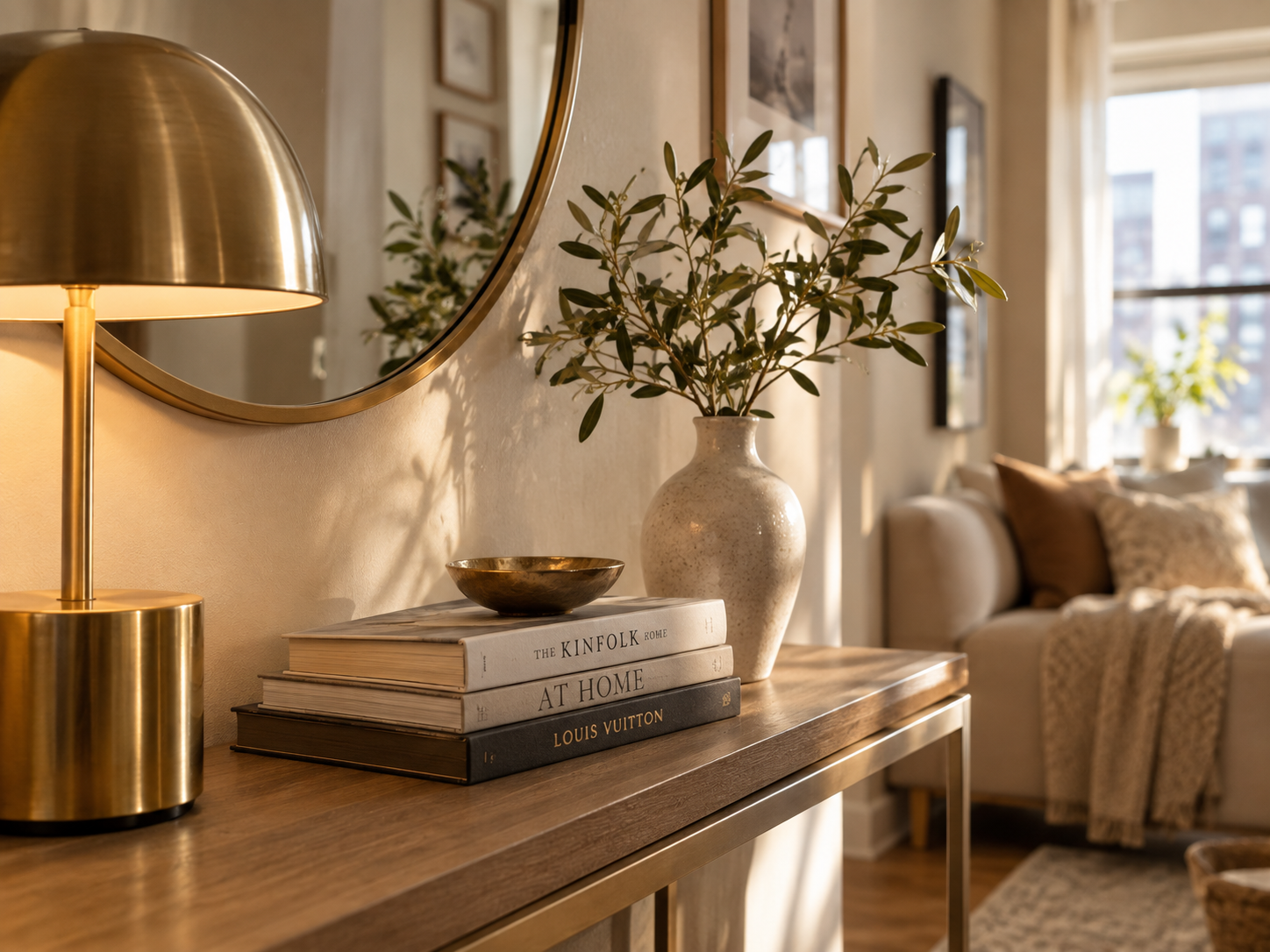
You don’t need every corner of a small apartment to be photo-ready — you need one. A console table with a lamp, a stack of books, and a single vase; a reading chair with a throw and a side table — these small vignettes give the eye a place to land and signal that the space was designed on purpose.
This is a favorite trick among stagers because it works even in otherwise imperfect rooms. One styled moment can carry the visual weight for an entire space — proof that the best small apartment decor ideas don’t need a big budget to look expensive.
Tip: Keep the vignette to three to five objects of varying height for the most polished look.
Need more layering inspiration? Our roundup of warm and cozy living room ideas is full of vignette examples worth stealing.
10. Disguise Storage as Decor
Baskets, lidded boxes, and upholstered benches with hidden storage let you tuck away the practical stuff — chargers, mail, remote controls — without resorting to plastic bins in plain sight. The goal is storage that looks intentional even when it’s doing double duty.
Small apartments accumulate visual noise fast, and hidden storage is one of the few small apartment decor ideas that solves both a style problem and a functional one at once.
Tip: A woven basket beside the sofa hides more than it looks like it could, and it costs a fraction of built-in storage.
11. Go Bigger With Art, Not Smaller
Instinct says small walls need small art, but the opposite is usually true. One oversized piece of art creates a focal point and reads as far more intentional — and expensive — than a cluster of small mismatched frames.
Large-scale art also tricks the eye into perceiving more wall space, since it implies the wall itself is generous enough to hold it.
Tip: A piece roughly two-thirds the width of your sofa or console is a safe, proportional starting point.
12. Give Your Entryway a Luxe Setup
Even a narrow hallway or a few feet inside the front door can function as a proper entryway with the right pieces: a slim console, a small tray for keys, a mirror, and a hook or two for bags and coats. This “arrival moment” sets the tone for the whole apartment before a guest even sees the living room.
Skipping this step is one of the fastest ways an apartment starts to feel like it lacks a plan, since shoes and bags end up piled wherever there’s room — which is why an entryway refresh is one of the easiest small apartment decor ideas to tackle first.
Tip: A slim 8–10 inch deep console fits in surprisingly tight entryways without blocking traffic flow.
13. Use Rugs to Define Zones, Not Just Cover Floor
In an open-concept studio, a rug isn’t just softness underfoot — it’s a boundary line. A rug under the sofa and coffee table signals “living room,” while a smaller one under a desk chair signals “workspace,” even without a wall between them.
This zoning trick is essential for studios and small one-bedrooms where furniture layout otherwise blurs into one undefined room.
Tip: Size up before you size down — a too-small rug is one of the most common reasons a “nice” room still feels off.
14. Add Greenery as a High-End Accent, Not an Afterthought
A single well-placed plant — a fiddle leaf fig in the corner, a trailing pothos on a shelf — brings life and softness into a room in a way that fake florals or dusty succulents rarely manage. Greenery also introduces organic texture, which pairs beautifully with the clean lines of small-space furniture.
This works because living plants signal care and attention, two things that read as inherently upscale.
Tip: One large statement plant almost always looks more designed than several small scattered ones.
Looking to bring this same high-end feel into your bedroom? Check out our elegant bedroom makeover ideas for beginners.
15. Respect Negative Space
The instinct in a small apartment is to fill every surface because empty space feels “wasted.” In reality, negative space is what allows the eye to rest and is a hallmark of high-end design — packed rooms read as cramped no matter how nice the individual pieces are.
Leaving a shelf partially empty or a wall intentionally bare isn’t neglect; it’s restraint, and restraint is what separates curated from cluttered.
Tip: Before adding one more object to a surface, ask whether it earns its spot — if not, it goes in a drawer, not on display.
5 Mistakes That Make Small Apartments Look Cheap
Even with the best small apartment decor ideas in place, a few common mistakes can quietly undo all that hard work:
- Furniture pushed against every wall. It feels efficient, but it often leaves an awkward dead zone in the middle of the room instead of a usable layout.
- Too many small rugs instead of one right-sized one. Scattered small rugs chop up the floor and make a room look smaller and busier.
- Mismatched metal finishes everywhere. Chrome faucets, brass lamps, and black hardware all competing in one small space reads as unplanned rather than eclectic.
- Overhead lighting as the only light source. It’s harsh, flat, and instantly recognizable as a rental setup rather than a styled home.
- Décor with no breathing room. Every shelf, wall, and surface filled to capacity signals clutter, not curation, no matter how nice each individual piece is.
Final Thoughts on Small Apartment Decor Ideas
Luxury in a small apartment was never about more stuff or more square footage — it’s about proportion, light, texture, and restraint working together on purpose. Pick two or three ideas from this list that fit your space and budget, execute them well, and resist the urge to do all fifteen at once. A few well-chosen changes, done properly, will always outperform a room full of half-finished ones. Start with the one that bothers you most every time you walk in the door — that’s usually where the biggest transformation is hiding.